

Starting an LLC in Michigan takes one formation document, one resident agent, and one payment, and the rest of the work happens in offices that sit outside the Corporations Division. The Articles of Organization create the company, and the division issues a six-digit file number when it accepts the filing. The LLC then owns its own name, holds its own bank account, and files an annual statement each February.
This page sets out the sequence in the order a founder actually follows it: the name check, the agent, the articles, the operating agreement, the tax accounts, the local licenses, and the first annual statement. It also covers the documents a bank will ask for and the charges the division publishes, so a founder can plan the cost before the filing rather than after it.
How to Start an LLC in Michigan
The order matters more than the forms. A founder who files the articles before checking the name can lose the filing fee on a rejection. A founder who appoints an agent without asking whether the agent will accept delivery ends up with a registered office that fails at the first notice. Work through the checks first, then file once, and keep the receipt with the company records.
A founder who works alone can complete the whole sequence in a week, and a founder with partners should allow two. The name check and the agent appointment take an afternoon, the articles take an hour, and the tax accounts take a few days to clear. Building the calendar first keeps the filing from stalling on a signature that nobody chased.
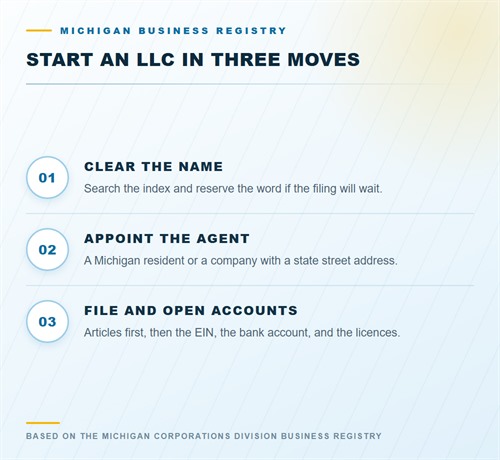
Choose a Name
Search the registry for the distinctive word, then the whole name, then a version with another ending. The state rejects a name that reads too close to one already on file, and the ending does not count in the test. A name that clears the check should be reserved if the filing will wait, because another applicant can take it in the meantime. The name must carry an accepted LLC ending.
Appoint a Resident Agent
The person or firm named must live or be organized in Michigan and keep a street address there. A post office box is refused, and the agent signs the articles to confirm consent. The owner can take the role when the owner lives in the state, and many small companies do exactly that. A commercial service keeps a home address off the public file.
File the Articles
The document states the name, the purpose, the office, the agent, and a signature from the organizer. The submission goes in through the portal, and the charge is paid by card at the end. The division reviews the document and issues the file number when it clears. A rejected filing is returned rather than refunded, so check every field before submitting.
Articles of organization:
https://www.michigan.gov/corpfileonline
Choosing the Business Name
The name is the first public decision the company makes, and it is also the one most likely to be refused. Michigan compares a proposed name against every entity and assumed name on file, and it sets the designation aside in the comparison. A founder who searches only the exact name can miss a close record, and a close record is enough to stop the filing. Run the short query first.
A name check is free, and it is the cheapest part of the whole formation. The registry search also shows the entity type and the status beside each result, which tells a founder whether a close record is an active company or an old one that has been closed. A closed record may still block a name if the statute treats it as confusing, so read the status before choosing.
Distinguishability
Two names conflict when a reasonable customer would treat them as the same business. A different ending does not cure the conflict, and a small spelling change usually does not either. Descriptive words such as “services” or “supply” carry little weight, so the distinctive word decides the result. A famous brand can block a name as misleading, even with no exact index match.
Assumed Names
An assumed name lets the LLC trade under a shorter brand without forming a second company. The certificate records the owner and the assumed name, runs for five years, and can be renewed. The filing is separate from the articles and carries its own charge. A founder who plans a brand name should file the assumed name after the LLC exists, because the certificate has to name an existing owner.
Appointing a Resident Agent
The resident agent is the party that accepts service of process and official notices for the company. Michigan requires one for the life of the entity, and the record shows the name and the registered office. The appointment is not a formality: a notice served on a stale agent can still bind the company, and a missed complaint can end in a default judgment.
Who Can Serve
A person serving in that role has to be an adult resident who can take delivery at a state street address. A corporate agent must be registered in the state and in good standing. The company cannot act as its own agent, and a mailbox store is not acceptable. A commercial agent usually charges an annual fee and forwards documents the same day.
The Address on the Record
Both the office and the agent address appear on the public file, and each must be a real Michigan location. A home office is allowed, and it becomes part of the public file. An owner who prefers privacy can use a commercial office or an agent address. The principal office, where the business actually operates, is a separate field and can be the same place.
Filing Articles of Organization
The articles are short, and the portal accepts them in a single session. The form asks for the company name, the purpose, the registered office, the resident agent, and the organizer’s signature. A professional company also names the licensed service it provides. The division checks the name, the addresses, and the signature before it accepts the document.
The purpose statement can be one or two sentences, and a general commercial purpose covers most companies. A very narrow purpose limits what the company may do, and a change later requires an amendment. A founder who is unsure should keep the purpose broad enough to cover the planned activity without describing a regulated business the company is not licensed to run.
Online Filing
The online route is the normal path, and it is faster than a paper document. The entry is compared with the index before payment is accepted. The acknowledgment arrives by email, and the file number appears on the receipt. A filer who needs a paper form can download one, but the online route saves a week.
Filing Fee
The articles carry a state fee that the division publishes on its schedule and on the checkout page. Expedited handling is available for an added charge, with a 24-hour option and faster tiers for urgent filings. The fee is charged again if the document is rejected and resubmitted, so a founder should review the form before paying. The Michigan business filing fees page lists the current amounts.
Operating Agreement
The agreement is the internal rulebook, and the state does not require it to be filed. It covers percentages, voting, distributions, and how a member joins or leaves. A single-member LLC can keep a short agreement, and a multi-member company should not operate without one. A founder should open the bank account before the first invoice, because a payment into a personal account blurs the line the liability shield depends on, and the account papers belong with the formation file. The state file does not carry the agreement, so a bank or a buyer will ask for it separately.
The agreement does not need a notary, and it does not need to be long. A short document that names the owners, the percentages, the manager, and the exit rule covers most of what a small company needs. A company that expects investors should add a section on admitting new members and on dilution. Review it once a year, and update it when the ownership changes.
What It Covers
A useful agreement names the members, their contributions, and their percentages. It states who manages the company, how a major decision is made, and what happens when a member leaves or dies. It also sets the tax treatment and the record-keeping duty. A company with an agreement can resolve a disagreement without a court, which is the practical value of the document.
Why It Matters to a Buyer
A buyer who purchases a membership interest needs to know that the transfer is permitted and that the other members consent. The agreement answers those questions, and a missing agreement leaves the buyer relying on the statute and on negotiation. A lender may also ask for a copy before it accepts a guarantee. Keep the signed agreement with the articles and the receipts.
EIN and Tax Accounts
The LLC does not receive a tax number from the division. The federal number comes from the IRS, and the state accounts come from the Treasury. Both are separate from the charter, and both are usually needed before the company hires, sells taxable goods, or opens a bank account.
The order is charter first, then the federal number, then the state accounts. A bank will not open an account without the EIN in most cases, and a sales tax account cannot be opened before the charter exists. A founder who tries to reverse the order usually ends up filing the same information twice. Keep the EIN letter with the formation receipt.
Federal EIN
The EIN is free and can be requested online once the LLC has a file number and a responsible party. A single-member company with default treatment may use the owner’s tax number, while a company electing corporate treatment needs its own. A bank usually asks for the EIN before it opens an account in the company name.
State Accounts
A retailer or a taxable service opens a sales tax account. An employer opens withholding and unemployment accounts through the state employer system. Every account has a separate application and calendar. The charter creates none of them.
Licenses and Permits
No single state licence covers every trade. Municipalities handle local permissions, and boards handle credentials for licensed work. A company can hold a valid charter and still need several permissions before it opens. The licenses sit outside the registry, and a founder should check them before signing a lease.
Local Licenses
A shop, a cafe, or a builder with premises should ask the city or county about a local license. Rules differ by place, and a move may need a fresh one. The local license is separate from the sales tax account and from the charter, and each office keeps its own record.
Professional Credentials
A professional LLC provides a licensed service, and its members must hold the credential. The state board issues the licence to the individual, and the company files a report listing the licensed members. A company that offers a regulated service without the credential can be stopped, even when its charter is active.
Bank Account and Records
A business bank account needs the articles, the file number, and the EIN, and most banks also ask for the operating agreement and a resolution naming the signers. A single-member LLC can open an account with the same documents, and the bank will still want proof that the company exists. Keep the formation receipt in the account file, because the bank may ask for it again at a review.
Open the account in the company name and never mix a personal card with a company expense, because the separation is what the liability shield rests on. A bookkeeper can set up the chart of accounts in an afternoon. A company that commingles funds gives a plaintiff an argument that the owners treated the LLC as an extension of themselves.
Documents the Bank Wants
A typical list includes the filed articles, the EIN letter, the operating agreement, and a photo identification for each signer. Some banks ask for a certificate of good standing, which is a separate order from the division. A company that opens the account soon after formation may need to wait a day for the record to appear in the registry.
Records to Keep
Keep the articles, the receipt, the operating agreement, the EIN letter, and the first annual statement confirmation in one folder. A company that changes its agent or address adds the notice and the confirmation to the same file. The folder answers a bank review, a buyer request, and a tax question without a search of the portal, and the first statement receipt shows a bank that the record is current.
The First Year
The LLC files its first annual statement in the February that follows formation, unless it was formed after September 30. The statement restates the registered office and the agent and carries the state fee. A late filing adds a penalty, and a second missed year removes the company from good standing.
The first statement is also the moment a founder sees the public record as a buyer sees it. The Michigan LLC records page shows which fields a counterparty reads first, and the statement is what keeps those fields current. A company that files early has a clean record for the rest of the year, while a late file spends the summer describing the gap.
Annual Statement Deadline
The statement is due on February 15, and the portal opens the filing about three months before the date. The form pre-fills the prior year’s details, and the fee is collected at the end. A company that changed its agent during the year should correct that field on the statement. Filing in January avoids the queue and the penalty.
Keeping Good Standing
Good standing is a matter of filing on time. A company that files early has the rest of the year free, while a company that waits risks a penalty and a warning on the record. A calendar reminder in December is the cheapest control. A company that lapses can restore, but the restoration carries a fee and leaves a gap in the history.
LLC Formation Fees
The division posts a charge for each LLC filing, and the list below covers what a new company will most often pay. The online checkout adds nothing beyond the listed fee, and expedited handling is quoted as an addition. A rejected document is returned rather than refunded.
| LLC item | State fee |
|---|---|
| Articles of organization | $50 |
| Name reservation | $25 |
| Certificate of assumed name | $25 |
| Annual statement | $25 |
| Good standing certificate | $10 |
| Certified copy of the articles | $16 plus $1 per extra page |
| Expedited 24-hour filing | $50 additional |
Frequently Asked Questions
These questions come from founders who are forming a first company or a second one. Each reply points to the filing or the office involved.
How much does it cost to start an LLC in Michigan?
The formation fee is listed in the table above. A name reservation, an assumed name, and a certificate are separate orders. A formation charge is paid once, and the annual statement follows each February.
Do I need a lawyer to form an LLC?
No. An owner can file a simple single-member company. Several members or a licensed service usually warrant a lawyer. A conversion, a multi-member buy-sell, or a licensed service is where advice earns its fee.
How long does approval take?
Most online submissions clear within a few working days. A 24-hour expedited request moves the document ahead for an added charge. A rejected document is returned rather than refunded, so check the name and the agent signature first.
Can I form an LLC without an operating agreement?
Yes, and the state does not require one. A bank, a buyer, or a lender will usually ask for it, so most companies keep one. A short agreement still beats none, because it names the owner and the exit rule.
When is the first annual statement due?
On February 15 of the year after formation, unless the LLC was formed after September 30, in which case the first statement is due a year later, and the reminder reaches the agent by mail, while the portal opens the filing months before the date. A founder should calendar the due date in December. Keep the first receipt with the formation documents, because a bank may ask for the sequence later.