

Michigan business name search is the check a founder runs before paying for a filing and the check a buyer runs before trusting a brand. The Corporations Division searches the same index that holds every organized entity, every registered foreign entity, and every assumed name on file. A name that clears the index is not automatically protected, but a name that fails it will not be accepted on a formation document.
This page covers the search itself, the rules that decide whether a name is distinguishable, the reservation and assumed name filings that sit beside a formation, and the point at which a federal trademark check becomes necessary. It is written for a founder choosing a name, a business adding a brand, and a buyer confirming that a trade name belongs to the entity behind it.
How to Check a Michigan Business Name
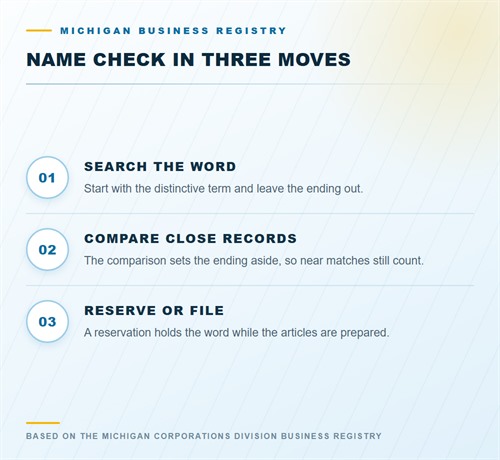
The portal search accepts a word or a phrase and returns every entity and assumed name that carries it. Start with the distinctive word rather than the full name, because the list is what shows a close match. The same index is reachable from Michigan Business Name Search on the home page. A reader who searches only the exact proposed name can miss a record filed with a different ending or a different punctuation, and that record is enough to stop a filing.
A name check is not a one-time task. Run it before the reservation, again before the articles are filed, and once more before the signage is ordered, because another filer can land in between. The check costs nothing and takes a few minutes, while a refusal costs a filing and a delay. A founder who builds the check into each stage avoids the surprise of a name that was clear last month and is blocked today.
Search the Index
Type the distinctive portion and leave out the designation. A query for “Copper Creek” returns an LLC, a corporation, and an assumed name that share the words, and the entity type beside each result tells you which class you are looking at. The search does not rank results by relevance, so the order on the screen means nothing. Read the list, then open the records that carry the closest match.
Compare the Results
A close result is not automatically a conflict, but it is a reason to look further. Compare the distinctive words, the ending, and the entity type, then decide whether a customer would confuse the two businesses. Michigan applies a distinguishability test rather than a spelling test, so a single changed letter usually does not clear a name that reads the same aloud. When the list shows a close record, choose a different word rather than adding a suffix.
Check Assumed Names
An assumed name is filed separately from a formation, and it does not appear in the entity list unless the reader looks in that index. A name that clears the entity list can still be taken as an assumed name by an existing business. Search both, and read the certificate that ties the assumed name to its owner. A brand that belongs to another company is a conflict even when no entity carries it as a legal name.
Name filing pages:
https://www.michigan.gov/corpfileonline
What Makes a Name Available
A name is available when no record on file is confusingly similar and the proposed name follows the rules for its entity class. The division checks the index when the document is reviewed, and a name that passed a search last month can fail if another filing landed in between. Availability is a snapshot, which is why a reservation exists and why a founder should file soon after a clearance.
Distinguishability
Two names conflict when a reasonable person would treat them as the same business. The ending is set aside in the comparison, so “Northwood LLC” and “Northwood Inc.” can conflict if the distinctive words match. A word such as “supply” or “services” adds little, so the distinctive term carries the decision. A name that copies a well-known brand can also be refused as misleading, even when the index has no exact match.
Required Endings
An LLC must carry Limited Liability Company, L.L.C., or LLC. A profit corporation must carry Corporation, Incorporated, or Limited, or an accepted abbreviation. A nonprofit corporation uses a corporate ending as well, and its articles state the nonprofit purpose. A limited partnership uses Limited Partnership or LP. A name that misses the ending is returned even when every other word is available.
Restricted Words
A name that suggests a bank, an insurer, a trust company, or a government body can need a consent before the division accepts it. Words such as “credit union” or “university” fall under separate statutes, and a professional practice adds its own licensing condition. The division reviews the word in context, so a founder who wants a regulated term should ask before filing rather than after a rejection, and should put the question in writing so the answer can be kept with the file.
Name Reservation
A reservation holds a cleared name for a limited period while the formation documents are prepared. It is optional, and it is useful when a founder needs time to gather signatures or to confirm a lease. The reservation does not create an entity, and it does not protect the name from a federal trademark claim. It only keeps the division from accepting the same name from another filer during the term.
A founder who is still comparing two names should reserve the one that is hardest to replace, because a distinctive word is scarce and a descriptive one is not. The reservation is a placeholder rather than a decision, and it can sit unused while the business plan changes, so a founder who needs more time files again. A founder who reserves a name and then chooses another can let the first lapse without a filing.
How to Reserve
The application identifies the proposed name, the entity class it is intended for, and the applicant. The division checks the index and issues a reservation when the name clears. The reservation is tied to the applicant, and it can be transferred with a short filing. Keep the confirmation with the formation documents, because the filing references the reservation.
Term and Renewal
A reservation runs for a set term and then expires unless the entity is formed. A founder who lets it lapse may find the name taken by another filer, and the division will not hold it. The charge for a reservation is modest, and it is separate from the formation charge. A second reservation after a lapse is treated as a new request rather than a renewal.
Assumed Names
An assumed name lets an existing business trade under a different name without forming a second entity. The certificate records the owner, the assumed name, and the term, and it appears in the index beside the legal names. A business that markets several brands files a certificate for each one. The filing is a disclosure rather than a grant of rights, and it does not stop another business from using a similar name in another line of trade.
Certificate of Assumed Name
The certificate identifies the entity that owns the name, the address, and the name itself. It is signed by an authorized person and filed with the division for a fee. The record then shows the assumed name and the owner, which is what a customer or a buyer needs to trace a storefront back to a registered business. A certificate filed by a sole proprietor works the same way and names the individual.
Renewal and Expiry
An assumed name runs for five years and then expires unless it is renewed. A renewal is a short filing with its own charge, and it must be filed while the underlying entity is in good standing. A business that lets the certificate lapse can keep trading, but the name is no longer registered, and a buyer who checks the index will not find the link. The Michigan LLC records page covers the entity record behind the name.
Names for an LLC
An LLC name is checked against the same index as every other class, and the ending is set aside in the comparison. The distinctive word carries the weight, and a professional LLC adds a licensing condition that can restrict the words it may use. A founder who plans to convert to a corporation later should choose a name that works for both classes rather than one that depends on the LLC ending.
A name that reads well on a sign is not always a name that reads well in a contract. Short words are easier to remember, and unusual spellings are easier to search, but a spelling that departs from the sound can create a lifetime of correction. Test the name aloud, then test it in the state index, and only then commit to the filing.
Professional LLC Names
A professional LLC provides a licensed service, and its name usually has to identify the profession. The members must hold the licence, and the name cannot suggest a service the members are not licensed to provide. A professional LLC files the same formation document with an added report, and the annual filing carries a higher charge. A name that fits an ordinary LLC may fail for a professional one.
Names That Suggest a Larger Business
A name that implies offices, branches, or a national operation can be refused when the entity is a single small company, because the name would mislead a customer. The division applies the same test to a name that suggests a government connection. A founder who wants a broad word should be ready to show that the business actually operates that way, or choose a narrower word.
Names for a Corporation
A corporation uses a corporate ending, and the name is checked against the same index. A profit corporation and a nonprofit can both carry “Corporation” or “Incorporated”, so the type field is what separates them in the result list. A nonprofit repeats its purpose in the articles, and a name that suggests a charitable mission has to match that purpose.
Profit and Nonprofit Endings
Both classes use a corporate ending, and neither may use an LLC ending. A nonprofit that intends to seek federal exemption should avoid a name that suggests a private benefit, because the name and the purpose are read together. The division does not grant the exemption, and a state-approved name does not by itself produce a favorable federal determination.
Reserved and Registered Names
A corporation can reserve a name while the articles are prepared, and the reservation runs for a set term. A foreign corporation that wants to protect its name without qualifying can register the name for a calendar year and renew it. Those filings sit beside the reservation and carry their own charges. A reader who sees a registered name in the index should check whether it belongs to an active entity or to a name registration.
Trademark Checks Beyond the State
The state index is not a trademark register. A name that clears the division can still infringe a federal mark or an unregistered brand that another business has used in trade. A founder who plans to spend money on signage and a website should run a federal search before the launch, and should treat the state clearance as one part of the check rather than the whole of it.
A search of the federal register is free, and it takes less time than a rejected application. The result shows the mark, the class of goods or services, and the owner, and it shows whether the mark is live or abandoned. A live mark in the same class is a warning, while an abandoned mark may still carry residual goodwill. Read the status field before assuming that an old registration is free to use.
Federal Register
The United States Patent and Trademark Office publishes a searchable register of marks, and a search there shows whether a similar mark is registered or pending for the same goods or services. A state-cleared name that matches a federal mark can still be challenged, and the challenge usually costs more than the formation. A founder who intends to trade across state lines should search before filing the articles.
Unregistered Rights
A business that has used a name without registering it can still hold rights under unfair competition law. Those rights are local and fact-dependent, and a state search will not reveal them. A founder who operates in a small area may accept that risk, while a business that plans to expand should take advice before adopting a name that another local business already uses.
When a Name Is Refused
A refused name is not a permanent bar. The division returns the document with a reason, and the filer can amend the name and resubmit. The resubmission is a new filing with a new charge, so a founder should correct every issue at once rather than one at a time. A consent from another entity can resolve a conflict when the two businesses are related.
Read the return letter closely, because the reason decides the fix. A similarity refusal needs a different distinctive word, while an ending refusal needs the right designation. A consent refusal needs a signed letter from the other owner, and a licensing refusal needs the credential. A founder who guesses at the fix usually pays for a second rejection. The Michigan business registration page shows where the name check sits in the filing sequence.
Similar Record on File
A close record is the most frequent reason for a refusal. The division compares the distinctive words and sets the ending aside, so adding “LLC” to a name that already exists does not clear it. A founder can choose a different distinctive word, add a word that changes the impression, or obtain a consent from the existing owner. A consent is a written document and does not transfer the name.
Wrong Ending or Missing Consent
A missing ending is a mechanical refusal, and it is fixed by amending the name. A restricted word without a consent is a substantive refusal, and it is fixed by obtaining the consent or by dropping the word. A name that suggests a regulated activity without the licence is refused as well. Read the return letter against the statute before resubmitting.
Name Fees
The division publishes a charge for each name filing, and the table below lists the amounts a founder or a business is most likely to encounter. A search costs nothing, and the charges begin with a reservation, an assumed name, or a formation. Expedited handling, where offered, is quoted as an addition.
| Name filing | State fee |
|---|---|
| Public name search | $0 |
| Application to reserve a name, LLC | $25 |
| Application to reserve a name, corporation or LP | $10 |
| Certificate of assumed name | $25 |
| Renewal of assumed name | $25 |
| Certificate of good standing | $10 |
Frequently Asked Questions
These questions come from founders, brand owners, and buyers who need to know whether a name is free. Each answer names the filing or the office that decides it.
Is a Michigan name search free?
Yes. The public index costs nothing to search and needs no account. Charges apply to a reservation, an assumed name, a formation, and a certificate. A search does not reserve the word, so another applicant can file while a founder is still deciding.
Does a state clearance protect my name?
No. It only clears the state index. A federal mark or an unregistered local brand can still take precedence in trade. A state clearance answers the registry, not the market, and a brand can be challenged after the filing.
How long does a reservation last?
A reservation holds the name for a limited term while the articles are prepared. It expires if no formation is filed, and a new request is needed after that. The hold is short, so a founder should file the articles before the term runs out.
Can I use a name another business abandoned?
Sometimes. A dissolved entity or an expired assumed name may free the word, but the index still shows the history, and another business may already be using it. Check the status before relying on it. An expired assumed name may still carry goodwill, so look at the storefront before adopting the word.
Do I need a name reservation to form an LLC?
No. Most founders file the articles directly. A reservation helps when the formation will wait on signatures or a lease, and it holds the word while the rest of the file is assembled. A founder who files directly should run the name check on the same day as the submission.