

Michigan LLC search opens the same public index that holds every business entity in the state, and the limited liability company has its own formation document and its own yearly obligation. The Corporations Division keeps the file, and the Articles of Organization create the company. The file names the company and its number, then reports the condition, the organization date, the addresses, the agent, and each submission.
This page covers the LLC side of the registry: the search routes, the fields on the record, the formation filing, the annual statement that keeps the company alive, the restoration route after a lapse, and the filings that change a name, an address, or an agent. It serves owners confirming their own file, buyers checking a supplier, landlords screening a tenant, and lenders who want a dated record of standing.
How to Search Michigan LLC Records
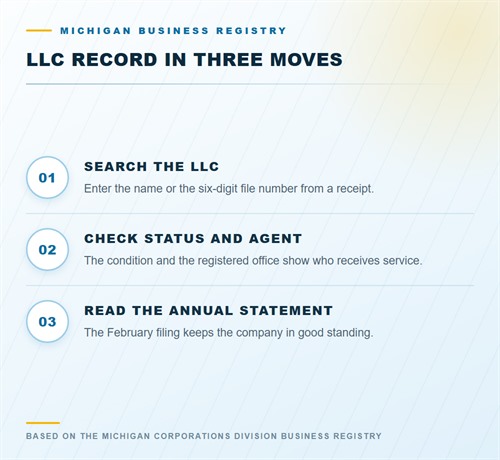
The portal accepts a name, a file number, or an identification number from a state document, and the LLC record opens from any of the three. The name route is the starting point when a company is known by its sign or its invoices. A reader who wants the wider register can start at Michigan LLC Search on the home page, then open the file. The number route is faster when a receipt or a statement is at hand. Neither route requires an account, and the lookup costs nothing.
Search by LLC Name
Enter the distinctive portion of the name and leave the ending out on the first pass. A query for “Lakeshore” returns companies, corporations, and partnerships that share the word, and that wider list is what shows a near match filed under a different ending. Michigan sets the designation aside when it compares names, so an LLC can sit close to an existing Limited Liability Company without an exact string match. Use the number from a filing receipt rather than the row order.
Search by File Number
A Michigan LLC carries a six-digit file number with no letter prefix. The number is assigned when the articles are accepted and stays with the company through every later filing, including a name change. Copy it from the formation receipt or from a certificate of good standing rather than from a directory site. One wrong digit returns an empty page, and an empty page is easy to misread as a company that does not exist.
Comparing Similar Results
Sort a long list by status and then by formation date. An active company with a recent formation date is usually the one trading today, while a dissolved record with a similar name belongs to an earlier attempt. Compare the registered office and the resident agent with the address on the invoice or the contract. When two active records share a name, the file number and the addresses are the fields that separate them.
Limited liability company pages:
https://www.michigan.gov/lara/bureau-list/cscl/corps/limited-liability-co
What an LLC Record Shows
An LLC record is a charter file, not a business profile. It reports the legal name, the entity class, the current status, the dates attached to each filing, and the addresses the company declared. It does not report revenue, employees, customers, or credit history. The record answers whether the company exists, who accepts service for it, and what it has filed, and those answers carry most of the weight in a routine verification.
Read the record from the top down, then check the history against the dates in your own file. A contract signed before an amendment refers to the earlier name, and a lease signed after an office change refers to the new address. The timeline is what ties the record to the transaction, and a reader who skips it can attach the wrong facts to the right company.
Identity and Status
The legal name and the file number identify the file, and the status says whether the registration is in force. An active LLC has filed its statements, while a company that missed two of them drops out of good standing by statute. A dissolved record shows the closure date and stays in the index. Read the status with the date of the lookup, because the same record can change within a season.
Registered Office and Agent
Service arrives at a physical Michigan address, and the agent is whoever receives it. A post office box is refused for either field. The two are often confused with the principal office, which is the place of business rather than the address for legal papers. A notice sent to the wrong field can leave a company without knowledge of a suit.
Filing History
The history shows each document the company has submitted, in the order the division posted it, with a type and a date beside every line. A quiet stretch does not prove inactivity, since a mailed document can arrive late. Use the list to find a filing, and use the condition field to judge where the company stands.
Forming a Michigan LLC
The Articles of Organization are short, and most of the work happens before the form is submitted. The organizer chooses a name that clears the index, gives a Michigan registered office, names a resident agent, and signs the document. The division accepts the articles and issues the file number, and the company exists from the effective date on the filing.
Formation does not produce a tax account, a bank account, or a license. Those come from separate offices, and each one asks for the file number or the accepted articles. A new company should keep the receipt with the filed articles, because the receipt carries the date and the number that every later form requests. A copy of the articles also belongs in the company records, next to the operating agreement.
Articles of Organization
The document asks for the company name, the purpose, the office, the agent, and the organizer’s signature. The name needs an accepted LLC ending, and both addresses have to be real Michigan locations. A professional company states its licensed service and files a longer yearly report. A missing signature or a box address is a frequent reason a filing is returned.
Name and Purpose
The name must be distinguishable from every entity and assumed name on file. A purpose statement of one or two sentences is enough, and a general commercial purpose covers most companies. A name that suggests a regulated activity, such as banking or insurance, can need a consent before the division accepts it. A reservation holds a cleared name for a short term while the articles are prepared.
Filing Fee and Processing
The articles carry a state filing fee published on the division’s schedule and on the portal checkout page. Standard review runs through the normal queue, and expedited handling is offered for an added charge, with a faster tier for same-day service. A card payment is taken at checkout, and a returned filing keeps the fee. Check the name, the addresses, and the signature before submitting.
Members and Managers
Michigan does not publish a member list for an LLC, and the public record does not identify the owners. The articles name the resident agent and the registered office, and the annual statement collects address data, but neither document exposes a membership schedule in the searchable index. A buyer who needs the ownership picture has to request it from the company or from the operating agreement, and should ask for a certificate that names the signers.
That gap is deliberate rather than an oversight. Michigan chose to keep the ownership schedule private, so a small company does not have to publish its owners to do business. The tradeoff is that a buyer cannot confirm control from the registry alone, and a contract with an LLC should include a representation about who holds the membership interests and who may sign for the company.
What the State Publishes
The public file shows the company name, the file number, the status, the addresses, and the filing history. It does not show capital contributions, percentages, or manager titles unless a later amendment restates them. A person-name search can return the record when that person is the resident agent, which is a role rather than an ownership interest, so treat the match as a lead. Treat such a match as a lead and confirm it with the company.
Operating Agreement
The operating agreement is an internal document, and Michigan does not require it to be filed. A company that keeps the agreement, the articles, and the receipts in one folder can answer a bank review without opening the portal, and the file number and formation date appear on every later form. It sets out the ownership percentages, the voting rules, the distribution schedule, and the process for admitting or removing a member. Because the state file does not carry it, a buyer or a lender who needs those terms has to ask for the document and a certification that it is current, and the request is routine in a purchase. A buyer should ask for a current copy. The absence of a filed agreement is normal, not a defect.
The Annual Statement
Every Michigan LLC files an annual statement, and the deadline falls on February 15. The statement restates the registered office and the resident agent, confirms the company details, and carries the state fee. A company formed after September 30 does not file on the February date that follows its formation, which gives a late-year organizer a longer first season.
The form is short, and most of it arrives pre-filled. Two questions follow, then the payment screen, and the receipt lands in the account history. An owner with several companies files one form for each, and a January filing avoids the last-week queue.
Deadline and Filing Route
The statement is submitted online, and the division no longer accepts a paper version. The portal opens the filing roughly three months before the due date, and it pre-fills the prior year’s details. A company that moved or replaced its agent during the year should fix those fields on the statement instead of repeating old values. Keep the confirmation with the company’s tax file.
Fee and Late Penalty
The statement carries a state fee, and a professional LLC pays a higher amount because it also files a report. A late statement adds a penalty, and the amount grows with the delay. A company that misses two statements loses good standing by operation of law, even before the division posts any notice. The penalty is avoidable, and the calendar reminder is the cheapest control.
Losing Good Standing
Good standing is lost through a missed statement rather than through a decision by the division. The record then carries a warning, and the company cannot point to the file as proof of compliance. A restoration filing brings the company back, and the history keeps both the lapse and the restoration. The gap stays visible to a buyer who reads the timeline.
Restoration Filing
A certificate of restoration of good standing is filed with every missing statement and the fee for each one. The restoration carries its own charge, and the division will not accept it without the statements. A company that restores after February 15 also includes the current year’s statement. The filing is made online, and the record updates when the division processes it.
Records After Restoration
After restoration, the status returns to active and the history shows the lapse and the recovery as separate entries. A lender reading the file can see that the company lapsed and returned, which is a different picture from a company that never lapsed. A certificate of good standing issued after the restoration states the current condition on its issue date. The Michigan certificate of good standing page covers the document.
Amendments and Agent Changes
An LLC changes its record by filing an amendment or a notice, and each route has its own form and its own charge. A name change, a purpose change, or a restatement runs through an amendment. A change of resident agent or registered office uses a shorter notice. Both filings post with a processing date, and both leave the earlier entries in the history.
A company that changes its name should update its bank signature card, its licenses, and its insurance policies in the same week. Those offices do not watch the registry, and a mismatch between the legal name and the account name can hold up a payment. A short checklist attached to the amendment keeps the private records aligned with the public one.
Name and Address Changes
A name change requires a cleared new name before the amendment is filed, and the old name stays in the history. The company updates its bank accounts, licenses, and contracts after the division accepts the amendment, because the state record does not notify those offices. An address change follows the same pattern, and an unfiled move leaves an out-of-date address on the file.
Resident Agent Notices
The form names the outgoing agent and the incoming one, and the incoming party accepts the role. The new agent must hold a Michigan street address, and the company cannot act as its own agent. The change takes effect when the division processes the notice, and a resignation without a replacement leaves a gap. That gap is the reason a resignation and a replacement are usually filed together.
Closing an LLC
An LLC ends through a certificate of dissolution. The filing states that the company has wound up its affairs, and the division closes the record when the document is accepted. The record then shows a dissolved status, and the company stops filing statements. A company that closes without filing leaves an active record behind, which can mislead a counterparty years later. A closed record still appears in the search, and its closure date is part of the file.
Certificate of Dissolution
The certificate identifies the company, the file number, and the effective date, and it is signed by an authorized person. The state charge is small, and the filing is short. Before the dissolution is filed, the company should settle its tax accounts with the Treasury and close any local license attached to the address. A dissolution with the division does not cancel a tax account or end a lease.
Obligations After Closure
Creditors can still pursue a dissolved company for obligations that predate the closure, and the state record is the evidence of when the company stopped existing. The owners should keep the final records for the period the statute requires. The guide to dissolving an LLC covers the wind-up sequence and the filings that follow.
LLC Fees
The division publishes a charge for each LLC document, and the amounts below cover the filings a company is most likely to order. The division reviews a standard filing in its regular queue, and a rush request adds a charge. A card payment is collected in the portal, and a returned document keeps the fee.
| LLC filing | State fee |
|---|---|
| Articles of organization | $50 |
| Annual statement | $25 |
| Amendment to the articles | $25 |
| Certificate of correction | $25 |
| Change of registered office or agent | $5 |
| Restoration of good standing | $50 |
| Certificate of dissolution | $10 |
| Standing certificate | $10 |
Frequently Asked Questions
These questions come from owners, buyers, and agents who work with Michigan LLC records. Every reply names the filing that decides the issue.
Is the Michigan LLC search free?
Yes. The public index charges nothing for a lookup and needs no account. Charges apply to filings, certificates, and copies. The lookup costs nothing at any hour, and a record opens without a login or a filing reference.
Does Michigan publish LLC members?
No. The public file shows the agent and the addresses, not the membership schedule. Ownership comes from the operating agreement or from the company. A buyer should request the agreement and a signed statement that names the current members.
Can one person own a Michigan LLC?
Yes. One person can organize the company, hold every membership interest, and serve as the sole manager, and the agreement should still name the owner. The document should also record the manager and the succession rule.
What happens if the annual statement is missed?
A penalty is added, and two missed statements cost the company its good standing. Restoration requires the missing statements and the fees. A company that restores after the February date may also owe the current year’s filing.
Does a foreign LLC file in Michigan?
Yes, once it obtains a certificate of authority from the division. It then files the same annual statement and keeps a Michigan resident agent, even when its office sits in another state, and the authority date differs from the formation date. The authority date is separate from the home formation date, which matters when a contract predates the registration.