

A Michigan certificate of good standing is issued by LARA’s Corporations Division, and it states that an entity exists and holds a given status on the day the document is printed. Banks, landlords, out-of-state registries, and licensing boards ask for it because it carries the division’s seal and a date, while a search printout carries neither. The certificate is short, and the information it certifies is narrow, which is exactly why a counterparty trusts it.
This page covers the request itself, the fields the certificate carries, the status that has to be in place before the division will issue one, the difference between a certificate and a certified copy, and the occasions that call for each. It also covers timing, because a certificate that is several weeks old may be refused even when it is genuine.
How to Request a Michigan Certificate of Good Standing
The request starts with the entity, and the division needs the legal name and the file number before it can produce the document. An online order through the registry portal is the fastest route, and the portal issues a downloadable certificate once payment clears. The record behind the document is reachable from Certificate of Good Standing Michigan on the home page. A paper request goes to the Corporations Division in Lansing and returns a sealed copy by mail. Both routes produce the same certificate, and both depend on the entity being in a status the division can certify.
Order Online
The portal order takes a few minutes when the entity is already identified by its file number. The applicant chooses the certificate type, pays by card, and receives a document that can be printed or forwarded to a counterparty. The online certificate carries the same seal and date as a paper one, and most banks now accept the electronic version. The account history keeps the receipt, which helps when a closing file needs a paper trail at a later date.
Order by Mail
A paper request lists the entity name, the file number, the certificate type, and a return address, and it includes the state fee. A mail request follows the same queue as any other document, and the certificate arrives with a raised seal. A paper certificate is still preferred by some registries, especially outside the United States. Allow mailing time on top of the division’s processing time when a closing date is fixed.
What the Request Needs
The legal name alone can be ambiguous when several entities share a distinctive word, so the file number removes the doubt. A request that names an assumed name rather than the legal name may be returned for clarification. The applicant should also state whether the certificate is for domestic use, for a foreign registration, or for a bank, because the wording of the request can affect which document the clerk prepares.
Certificate orders:
https://www.michigan.gov/fileonline
What the Certificate States
The document certifies a small set of facts and says nothing beyond them. It identifies the entity by legal name and file number, states the entity type, and gives the status on the issue date. It does not list owners, officers, revenue, licenses, or tax standing. A reader who needs those facts has to collect them elsewhere, and a certificate that is asked to prove more than it states will not carry the weight the requester expects.
A counterparty who needs more should be given a second document rather than a longer explanation. A certified copy of the articles proves how the entity was formed, a certificate of fact lists the filings, and the last annual statement receipt proves the report arrived. Building the file from the right documents is faster than arguing about what the certificate means.
Name, File Number, and Status
The legal name on the certificate matches the name in the registry on the issue date, and the file number ties the document to the record. The status line reads as active or another value the division uses. A certificate issued for a foreign entity also shows the home jurisdiction. The three fields together let a counterparty confirm that the document belongs to the entity in front of them.
Issue Date and Seal
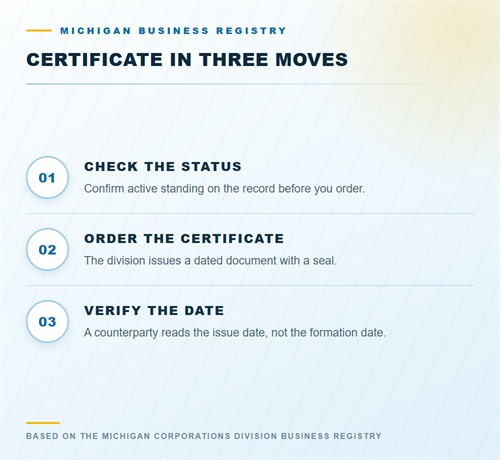
The issue date is the day the division produced the document, and it is not the date the entity was formed. The seal is the division’s authentication, and a photocopy of a sealed certificate is usually accepted only when the counterparty can verify it against the registry. A certificate without a date or a seal is a printout, and a printout is not evidence of standing. Check both before you forward the file.
Status Before You Order
The division can certify only the status that exists on the day of the request. An entity that has missed its statements is not in good standing, and a certificate issued for that entity states the condition rather than hiding it. A requester who expects an active certificate should confirm the record first, because an order placed on a lapsed entity produces a document that will not satisfy a bank.
Active Records
An active record produces a certificate that a bank, a landlord, or a registry will accept without further explanation. The certificate still carries only the date and the status, so a counterparty with a stricter policy may also ask for the last statement receipt. An active entity can order the certificate at any time, and the portal issues it within the same session in most cases.
Lapsed and Dissolved Records
An entity that is not in good standing can still request a certificate, and the document will state the condition. That is useful when a buyer needs to prove the current state of a supplier, but it will not satisfy a bank that requires active standing. A dissolved entity produces a certificate that states the dissolution. Confirm what the counterparty will accept before paying for a document that reports the wrong condition.
Certificate and Certified Copy
The two documents come from the same office and are often confused. A certificate of good standing is a statement about the entity’s condition on a date. A certified copy reproduces a document already on file, such as the articles or an amendment, and attests that the copy matches the record. A bank that asks for proof that the company exists wants the first. A lawyer who needs the exact text of a merger wants the second.
Both documents are ordered from the same portal, and both carry a seal. The difference is what they attest: one speaks to the condition of the entity, and the other speaks to the accuracy of a filed page. A requester who orders the wrong one usually finds out at the counter, which is the most expensive place to learn the distinction.
Different Documents
The certificate of good standing is one page and carries a standard statement. A certified copy can run to many pages, and the charge includes a per-page amount on top of the certification. The certified copy does not state the current status unless the underlying document does. A requester who needs both should order them together, because the division can prepare them in one request.
Which One a Counterparty Wants
Read the request literally. A bank that asks for a “certificate of good standing” wants the status certificate, and a title company that asks for “certified articles” wants the copy. A foreign registry often asks for both, because it needs the current status and the document that created the entity. Sending the wrong one costs a delay and a second fee, and the division does not refund the first order.
Where the Certificate Is Used
The certificate travels with the entity into situations where a third party needs independent proof of existence. A lender opens a credit line, a landlord signs a long lease, a state registry accepts a foreign registration, and a licensing board reviews an application. In each case the certificate answers a narrow question, and the rest of the review continues with other documents.
The document also appears in routine file maintenance. A company that keeps a bank covenant, a government contract, or a bond facility usually has to refresh its certificate on a schedule. A treasurer who tracks those dates avoids a last-minute order before a renewal. The same habit helps when a supplier asks for proof at the start of a new year, because the file already holds a current copy.
A company that holds several entities should keep one certificate per entity in the same folder, because a bank may ask for the group rather than the borrower alone. A parent that guarantees a lease is often asked to prove its own standing as well. Ordering the certificates together saves a second session and keeps the dates aligned, and a file with one date is easier to describe, while a second copy can go to the lender directly.
Banks and Lenders
A bank usually wants a certificate dated within the last thirty to ninety days, depending on its policy, and it may also ask for the operating agreement or the bylaws. The certificate confirms that the borrower exists and is current, and the credit decision rests on the financial file. A certificate issued before a lapse is still genuine, but it describes a condition that no longer holds.
Out-of-State Registrations
An entity that registers in another state usually has to supply a certificate from Michigan with the application. The other state wants proof that the home charter is in force, and it sets its own age limit for the document. Order the certificate close to the filing date, and check the other state’s instructions for the exact wording it requires. A certificate that is correct in Michigan can still be refused for being too old.
Timing and Validity
The division produces an online certificate within the same session, and a paper certificate takes longer because it goes through the mail. The document does not carry an expiration date, but the reader applies one. A counterparty that requires a certificate from the last ninety days is applying its own rule, and the division has no say in it. Order when the file is ready to close rather than when the deal is first discussed.
A closing that depends on a sealed paper certificate should allow a week for delivery, and a foreign registry may add a courier stage. A domestic bank that accepts an electronic copy can be satisfied the same day. Ask the counterparty which format it accepts before the order, because the answer decides whether a mail request is needed at all.
Delivery
An online order that clears payment produces a downloadable document, and the email address on the account receives the confirmation. A mail order adds the division’s processing time and the postal time. An expedited order moves the document ahead in the queue for an added charge, and the fee is a percentage of the document charge rather than a flat amount.
Age Limits
The certificate speaks only to its issue date, and a later lapse does not make the earlier document false. A reader who relies on an old certificate is relying on an old fact, which is why most institutions refresh the document before a new transaction. A company that orders once a year for its bank file should order again when the bank asks, because the bank will read the date on the page.
When the Certificate Cannot Be Issued as Requested
The division issues a certificate for any entity on the registry, but the status it states may not be the one the requester wants. A lapsed or dissolved entity still produces a document, and the document reports the true condition. The refusal comes later, from the bank or the registry that reads it. A requester who needs an active certificate has to restore the status first.
Restoration First
Restoration requires the missing statements or reports, the charges attached to them, and a certificate of restoration with its own fee. Once the division accepts the filing, the status returns to active and a new certificate reflects the change. The record keeps the lapse and the restoration in the history, so a reader can see the gap. Order the certificate after the restoration posts rather than on the same day.
Dissolved Entities
A dissolved entity cannot be restored through the ordinary route, and a certificate will state the dissolution. A buyer who needs the history of a dissolved company should order a certified copy of the dissolution and a certificate of fact that lists the documents filed. Those records show what the entity filed and when it ended, which is often what a dispute actually needs.
Verifying a Certificate
A certificate is easy to check, and a buyer should check every one that arrives from a seller. Compare the legal name and the file number with the registry, confirm the status on the issue date, and look at the seal and the printed date. A document that names a different entity, carries no file number, or shows a date in the future is a reason to stop and ask.
The registry is free to search, so the check costs a few minutes. A buyer who skips it can accept a genuine certificate for the wrong company, which is the most frequent problem in a closing file. A short note in the file records the check, the date, and the person who made it.
Check the File Number
The file number on the certificate should match the identifier on the entity record and on the contract. A certificate for a similarly named affiliate is a frequent substitution, sometimes by accident and sometimes not. The entity type also confirms the class, so a corporation named on an LLC certificate is a mismatch. A single lookup on the number settles the question faster than a call. The registered agent record helps when the certificate names an agent you do not recognize.
Check the Date
The issue date should be recent enough for the purpose the document serves, and the status should match the registry on that date. A certificate issued before a lapse is genuine but stale for a new loan. A certificate with a date that does not appear in the division’s records is a forgery, and the registry is the authority, so keep the verification note with the file. Keep the electronic copy with the date visible when the file is stored, and add a note of the date it was checked.
Certificate Fees
The division publishes a charge for each certificate and copy, and the amounts below cover the documents a business or a requester is most likely to order. Expedited handling is a percentage of the document charge. A card payment is taken at checkout, and a refused request keeps the fee. The Michigan business filing fees page lists the formation and report charges beside these amounts.
| Document | State fee |
|---|---|
| Good standing certificate | $10 |
| Certificate of status, LLC | $10 |
| Certificate of fact, other | $20 |
| Certificate listing every filing | $50 |
| Certified copy, sealed | $16 plus $1 per extra page |
| Rush certificate order | 25% of the document fee |
Frequently Asked Questions
These questions come from borrowers, registrants, and buyers who need a dated statement. Each reply names the office or the record that resolves it.
Is a certificate of good standing the same as a certificate of status?
In practice, yes. The corporate and LLC versions report the condition on a date in the same format. A registry in another state may use either name in its instructions, so ask the counterparty which wording it wants before ordering.
How long is the certificate valid?
The document has no expiry date, but most institutions require one issued within the last thirty to ninety days. A file that holds last year’s copy is a renewal waiting to happen, so order a fresh one for each closing.
Can I get a certificate for a company that is not in good standing?
Yes, and it will state the condition. A bank that requires active standing will not accept it until the entity is restored. Start the restoration before the closing date, because the certificate follows the restored record.
Does the certificate list the owners?
No. It identifies the entity, the file number, the entity type, and the status. Ownership is not part of the document. A shareholder or member list is not published, so a buyer has to ask the company.
Can I order a certificate for a foreign entity registered in Michigan?
Yes. The division issues a certificate for a registered foreign entity, and the document shows the home jurisdiction. A foreign entity that has withdrawn its authority produces a certificate that states the closure instead. Order it close to the filing date, because the other state sets its own age limit.