

Michigan business filing fees are set by statute and published by the Corporations Division, and they are charged per document rather than per year. A founder pays once to create the entity, again for each change, and each February for the annual statement or report. The amounts are modest compared with the cost of a missed deadline, which is why the fee schedule belongs in the same folder as the calendar.
This page collects the charges a small business is most likely to meet, separates the formation fees from the recurring ones, and marks the filings that sit outside the division entirely. It is written for a founder budgeting a first year, an owner comparing a late filing with a restoration, and a buyer checking whether a quoted cost is a state fee or a service fee.
How Michigan Business Filing Fees Work
The division charges a fixed amount for each document, and the amount does not depend on revenue, employee count, or the size of the business. The charge is collected when the document is filed, and a rejected document is returned rather than refunded. Expedited handling is a separate amount added to the document fee, with tiers that rise as the promised turnaround shortens.
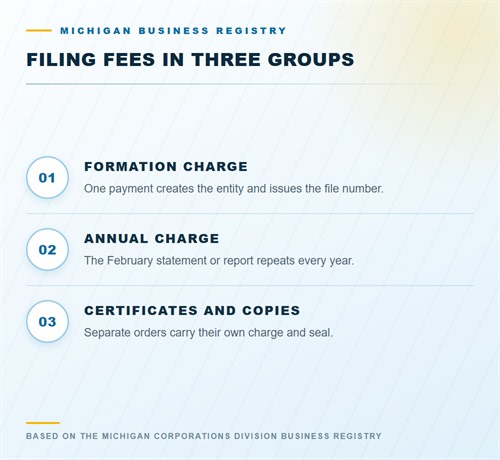
A fee schedule is easier to use when the documents are grouped by purpose rather than by form number. The formation group answers what it costs to exist, the annual group answers what it costs to stay active, and the change group answers what it costs to alter the record. A founder who budgets by group can see the first-year total before the filing, which is the number that matters to a bank or an investor.
What the Division Charges
The division charges for formation, amendments, annual filings, certificates, and copies. It also charges for a name reservation, an assumed name, a restoration, and a dissolution. Those documents cover almost everything a small company needs, and each one appears on the published schedule with a fixed amount. The schedule changes when the legislature changes it, so confirm the figure on the division page before paying.
What the Division Does Not Charge
The public entity search costs nothing, and the division does not charge for a login or for viewing a record. It does not charge for a name check, and it does not charge for a report reminder. The state also does not levy a general business licence fee, because Michigan has no such licence. A quote that includes a “state business licence” is either a local licence or a service fee from a filing company.
Corporations Division fees:
https://www.michigan.gov/lara
Formation Fees
The formation fee depends on the entity class. An LLC pays a single document fee, while a profit corporation pays a document charge plus an organization charge. A nonprofit pays less. The differences are small in absolute terms, but they matter when a founder is comparing structures with a budget in hand.
A founder who compares the classes should add the first annual charge to the formation charge, because the second amount arrives within a year. An LLC that forms in March pays the statement fee the following February, and a corporation pays the report fee on the same schedule. A founder who forms after September 30 gets a longer first season, which changes the first-year budget by one annual charge.
LLC Formation
The Articles of Organization carry a fixed charge, and the online checkout collects it with the filing. A professional LLC pays the same formation charge and a higher annual amount, because it files an additional report. A founder who reserves a name pays a separate charge for the reservation, and the reservation does not reduce the formation fee.
Corporation Formation
A profit corporation pays a document fee plus an organization fee tied to the authorized shares, and the combined amount is quoted on the form. A nonprofit corporation pays a smaller amount and files a shorter document. A foreign corporation pays a comparable amount when it registers, and the charge includes the initial franchise element that the statute sets.
Annual Filing Fees
Every LLC and corporation files a statement or report each February, and the charge recurs for as long as the entity exists. The amount is fixed for the class, and a late filing adds a penalty that grows through the spring and summer. The annual charge is the largest lifetime cost for a small company, because it repeats every year without exception.
The annual charge is not a tax on profit. It is a fee for keeping the record active, and it applies whether the company earned a dollar or not. A dormant company still files and still pays, and a company that stops filing loses its standing. A budget that treats the annual charge as optional is the source of most restorations.
LLC Annual Statement
The LLC statement carries a fixed charge, and a professional LLC pays a higher amount with a report attached. A late statement adds a penalty, and the penalty is separate from the fee. A company that files in January pays only the standard amount and avoids the queue that builds before the deadline.
Corporate Annual Report
A profit corporation pays a fixed report fee on time, and a late report adds a penalty that rises by month until it reaches a ceiling. A nonprofit corporation pays a smaller report fee and files a shorter form. A corporation that ignores the report loses good standing, which turns a small charge into a restoration filing and a gap in the record.
Name and Assumed Name Fees
Name filings are optional but frequent. A reservation holds a cleared name while the articles are prepared, and an assumed name records a trading style for an existing owner. Each filing carries its own charge, and neither creates an entity. A founder should treat the name charges as part of the launch cost rather than as an afterthought.
A reservation is worth the charge when the formation will wait on a lease or a signature, because a cleared name can disappear in a week. An assumed name is worth the charge when the company wants a brand that differs from its legal name, because the certificate lets a customer trace the brand to the owner. Neither charge is large, and both prevent a more expensive correction later.
Name Reservation
The reservation charge depends on the entity class, with the LLC amount higher than the corporation amount. The reservation runs for a limited term and expires if the formation does not follow. A second reservation after a lapse is a new request with a new charge. The reservation does not include a name search, which is free.
Assumed Name
A certificate of assumed name carries a fixed charge and runs for five years. A renewal carries the same charge and can be filed while the owner remains in good standing. A business with several brands pays for each certificate. An expired certificate leaves the name unregistered, which can confuse a buyer who checks the index.
Change and Amendment Fees
A change to the record is a filing with its own charge, and the amount depends on the document. An amendment to the articles carries one amount, a correction carries another, and a change of registered office or agent carries the smallest charge on the schedule. A company that plans several changes in one year should file them together where the statute allows.
The cheapest filing on the schedule is the change of registered office or agent, and it is also the one most often skipped. A company that moves and does not file leaves a stale address on the record, which is where a missed lawsuit begins. The fee is small enough that there is no reason to delay the notice.
Amendments and Corrections
An amendment changes a name, a purpose, or a share structure, and it carries a fixed charge. A restatement replaces the articles in full and may carry a different amount. A certificate of correction fixes a clerical error and carries its own charge. A correction does not change the underlying decision, which is why it is cheaper than an amendment.
Agent and Office Changes
A notice of change of registered office or agent carries a small charge, and it is the least expensive filing a company will make. The filing identifies the former agent and the new one, and the new agent signs. A move that is never filed leaves a stale address on the file, which is a bigger risk than the fee.
Certificate and Copy Fees
A certificate is a separate order, and the charge depends on the type. A certificate of good standing costs less than a certificate of fact that lists every document on file. A certified copy is charged by the page after a minimum, and an expedited certificate adds a percentage of the document charge. A requester should confirm which document the counterparty will accept before ordering.
A certificate is a small line in a closing budget, and it is the document a bank will not proceed without. A buyer who orders the wrong certificate pays twice, because the division does not refund the first order. Read the instruction from the counterparty and order the exact document it names.
Good Standing and Status
The corporate and LLC certificates carry one small charge. Both state the condition on the issue date and carry a seal. A certificate of fact that lists the filings costs more, and it is the document a buyer orders when the history matters. The certificate of good standing page covers the request route.
Certified Copies
A certified copy carries a minimum charge for the first six pages and a per-page amount after that. A long merger document can cost more than the formation itself, which is why a requester should ask for the specific document rather than the whole file. An uncertified copy costs less and is enough for internal use in most cases.
Restoration and Dissolution Fees
A company that lapses pays a restoration charge plus the statements it missed, and a company that closes pays a dissolution charge. Both amounts are small compared with the cost of leaving the record wrong. A lapsed company that keeps trading risks a judgment it cannot defend, and a closed company that never files leaves an active record behind.
A restoration is cheaper than a new formation in most cases, even when several statements are owed, because the file number and the history stay intact. A founder who lets a company lapse and forms a new one loses the name, the formation date, and the record. The restoration route keeps the continuity that a lender or a buyer can read.
Restoration
The restoration filing carries a fixed charge, and each missed statement carries its own fee. A restoration filed after the February date can also require the current statement. The total can be several times the annual charge, which is the practical argument for filing on time. The record keeps the lapse and the restoration as separate entries.
Dissolution
A certificate of dissolution carries a small charge. The filing is short, and it closes the record when the division accepts it. A company that dissolves without settling its tax accounts may still receive a notice from the Treasury, because the division and the tax office do not share a closing stage. The guide to dissolving an LLC covers the sequence.
Expedited Service
The division offers faster review for an added charge, and the tiers rise with the promised turnaround. A 24-hour request is the least expensive tier, and a same-day or two-hour request costs considerably more. Expedited service does not change the review standard, and a defective document is still rejected at the higher price.
The expedited charge is a convenience rather than a requirement, and it does not move a defective document through review. A filer who pays for speed and receives a rejection has spent the money and lost the time. Review the name, the addresses, and the signatures before choosing a tier.
When to Use It
Expedited service makes sense when a closing, a lease, or a bank account depends on the filing. It rarely makes sense for a routine amendment that can wait a week, and a founder who weighs the charge against a delayed closing usually finds the standard queue adequate. A founder who needs the entity to exist on a specific date should file early rather than pay for speed, because the queue is predictable and the deadline is not.
Fees Outside the Division
The state fee is only part of the cost of opening a business. The Treasury charges nothing to open a sales tax account, but the account creates a filing duty. A local licence carries its own fee, and a professional credential carries an application fee and a renewal. Those amounts are set by the office that issues them, not by the Corporations Division.
A founder should write the outside charges into the same budget, because they arrive in the first month. A local licence, a health permit, and a professional application can each cost more than the formation fee. The division schedule is the smallest part of the opening cost for a regulated business, and a budget that stops at the charter understates the launch.
Tax and Local Accounts
Sales tax, withholding, and unemployment accounts are administered by the Treasury and by the state employer system. A local licence is issued by a city or county, and the fee varies with the activity and the location. A business that moves may pay a second local fee in the new jurisdiction. None of those charges appear on the division schedule.
Professional and Trade Fees
A professional credential carries an application fee, a licence fee, and a renewal cycle set by the board. A contractor registration and a food permit follow the same pattern. The fees belong to the individual or the premises rather than to the entity, and they continue even when the company changes its name.
Full Fee Table
The table below collects the amounts the division publishes for the filings a small company is most likely to order. The figures are state charges only, and a filing company may add its own service fee on top, so compare the two lines before paying. Confirm the amount on the division page before paying, because the schedule can change with a legislative session. A fee quoted by a filing company may include its own service charge, so compare the state line separately from the total on the invoice.
| Filing | State fee |
|---|---|
| Articles of organization, LLC | $50 |
| Profit corporation formation | $60 |
| Nonprofit formation | $20 |
| Annual statement, LLC | $25 |
| Annual report, profit corporation | $25 |
| Annual report, nonprofit | $20 |
| Name reservation, LLC | $25 |
| Certificate of assumed name | $25 |
| Change of registered office or agent | $5 |
| Amendment to the articles | $25 |
| Certificate of good standing | $10 |
| Certificate of fact, all documents | $50 |
| Restoration of good standing | $50 |
| Certificate of dissolution | $10 |
Frequently Asked Questions
These questions come from founders, owners, and buyers who are comparing a budget with a bill. Each answer points to the document or the office involved.
Is there an annual fee for a Michigan LLC?
Yes. The annual statement carries a fixed charge each February, and a late statement adds a penalty that grows with the delay. The charge applies whether the company earned income or sat idle for the year.
Does Michigan charge a franchise tax?
Michigan does not levy a franchise tax on the charter. A business may owe other state taxes, and those are administered by the Treasury. The Treasury administers sales, withholding, and income taxes, and those sit apart from the charter.
Are filing fees refundable?
No. A rejected document is returned rather than refunded, and a corrected version is charged again at the full amount, even when the error was a single missing field. Review the name, the addresses, and the signature before submitting, because a second attempt costs the full amount.
Can I pay by card?
Yes. The online portal accepts a debit or credit card, and the paper route accepts a cheque or a money order payable to the State of Michigan. The paper route adds mailing time, and the online route settles at checkout.
Do I need a service to file for me?
No. The portal is built for owners, and the forms are public. A service is convenient, and its charge is separate from the state fee. A filing company is convenient, and its fee is separate from the state charge.