

Dissolving an LLC in Michigan takes a member decision, a final sweep of the company’s obligations, and one short filing with the Corporations Division. The certificate of dissolution closes the record, and the division stops sending annual reminders. The work that matters happens before the filing, because a closed record does not cancel a lease, a tax account, or a debt.
This page sets out the sequence in the order it should be followed: the approval, the wind-up, the tax filings, the certificate, and the records that stay behind. It is written for an owner closing a company, a buyer taking over a business that is winding down, and an adviser who needs to know which office holds each closing task.
How to Dissolve an LLC in Michigan
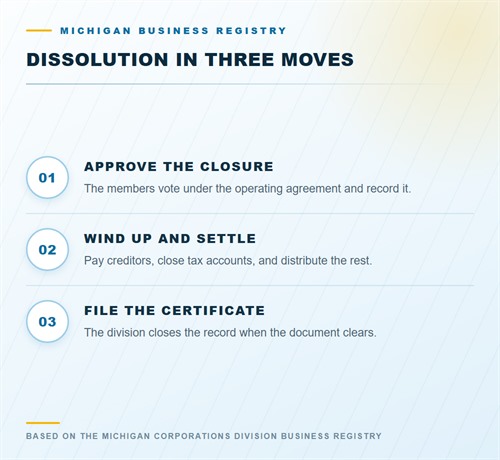
The process has three parts, and the filing is the smallest of them. First, the members approve the dissolution under the operating agreement. Second, the company collects its assets, pays its creditors, and distributes what remains. Third, the certificate of dissolution is filed with the division. A company that files first and winds up later leaves creditors without notice and owners with unresolved obligations.
The calendar matters as much as the paperwork. A company that closes in the middle of a lease term should give notice before the certificate is filed, because a landlord may need the premises surrendered on a date. A company that closes during a tax quarter should file the final return for the partial period. Write the dates down before the vote, so the closure sequence has a start and an end.
Approve the Decision
The operating agreement sets the vote required to dissolve, and a company without an agreement follows the default rule in the statute. A single-member LLC records the decision in writing, and a multi-member company records the vote and the date. The written record belongs in the minute book, because a buyer or a court may ask how the decision was made.
Wind Up the Business
Winding up means finishing the work that remains: collecting receivables, selling or distributing assets, paying creditors in the order the law requires, and closing the accounts. A company that stops operating without winding up leaves assets unclaimed and debts unpaid. The owners should keep a schedule of what was collected and what was paid, because the final tax return follows that schedule.
File the Certificate
The closing document names the company and its number, states the effective date, and carries an authorized signature. The document goes in through the portal, and the charge is one of the smallest on the schedule. The division closes the record when it accepts the document, and the public record then shows the dissolution date beside the earlier filings.
Dissolution filing:
https://www.michigan.gov/fileonline
Before You File
A company should not file the certificate until it knows what it owes and who is owed. A lease with two years left, a supplier contract with a termination clause, and a tax account with an open period all survive the closure of the charter. The owners who skip this review usually discover the obligation after the entity is gone.
A short checklist prevents most of the problems that follow a closure. The list covers the lease, the loan guarantees, the supplier contracts, the tax accounts, the employees, and the domain names and accounts held in the business name. A company that works through the list files the certificate with confidence rather than hope.
Debts and Contracts
List every contract, lease, loan, and guarantee in the company’s name, and note the termination terms. A lease often requires written notice and a surrender of the premises. A loan may carry a personal guarantee that survives the dissolution. A supplier contract may require payment for goods already ordered. Close each one in writing before the certificate is filed, or note in the file why it remains open.
Tax Accounts and Employees
Close the sales tax account with the Treasury, file the final withholding return, and settle the unemployment account. A company with employees should pay the final wages and issue the final statements on the normal schedule. A closed charter does not close a tax account, and the Treasury will keep sending notices until the account is formally closed.
Member Approval
The approval is a company decision rather than a state form. The operating agreement may require a majority, a supermajority, or the consent of every member, and the statute supplies a default when the agreement is silent. A company that skips the required vote can face a challenge from a member who did not consent, even after the certificate is filed.
A company with a buy-sell section in its agreement should read that section before the vote, because a closure can trigger a purchase obligation among the members. A member who wants to continue the business may have a right to buy the exiting interest. That right is easier to honor before the certificate is filed than after the record closes.
A member who disagrees with the closure has a limited set of remedies, and most of them depend on the operating agreement. A company that follows the agreement and records the vote is in a stronger position than one that relies on an informal conversation. The record is also useful when a buyer later asks why the company closed.
Operating Agreement Rules
Read the dissolution section before the vote, because the agreement may require a written notice period or a meeting. A member who holds a small interest can still block a dissolution when the agreement requires unanimous consent. A company that anticipates a closure should confirm the vote requirement early, so the process does not stall at the end.
Recording the Vote
The record should state the date, the members who voted, and the result. A single-member LLC can sign a written consent instead of holding a meeting. The document belongs in the company’s record book and should be kept with the certificate and the final tax return. A buyer who acquires the business later may ask for the record to confirm that the closure was authorized.
Winding Up
Winding up is the part that requires judgment. The company must convert its assets to cash or distribute them in kind, pay its creditors, and then distribute the remainder to the members in the proportions the operating agreement sets. A company that distributes to members before paying creditors can leave the members liable for the shortfall.
The company keeps its legal existence during the wind-up, which means it can still sign a settlement, collect a receivable, and transfer a title. That capacity ends when the certificate is filed, so the work should be finished before the filing. A company that needs to sell a vehicle or assign a lease should complete those tasks while the entity is still active.
Assets and Creditors
Start with the bank account and the fixed asset list, then add the receivables. Pay the secured creditors first, then the unsecured creditors in the order the statute sets. Keep the receipts and the correspondence with each creditor, because a dispute about priority is settled with documents rather than memory. A creditor who cannot be found should be noted in the file.
Distributions to Members
After the creditors are paid, the remainder goes to the members in the agreed proportions. A distribution in kind should be valued and recorded, because the value affects the final tax return. A member who receives property instead of cash needs a record of the value on the distribution date. The operating agreement may set a different rule, and the agreement controls.
Certificate of Dissolution
The certificate is short, and it is the document that ends the charter. It states the company name, the file number, and the effective date, and it confirms that the affairs have been wound up. The division accepts it online, and the record closes when the document clears. A rejected certificate is usually missing a signature or a file number.
The division does not require a tax clearance before it accepts the certificate, and that is why the tax accounts have to be closed separately. A closing owner who assumes the division will notify the Treasury usually receives a notice months later. The two offices keep separate records, and each one needs its own closing request.
The certificate should be filed by a person who has authority under the operating agreement, and the signature block should name the office held. A filing signed by someone without authority can be challenged, even after the record closes. A single-member company signs through the member, and a managed company signs through a manager named in the agreement.
What the Certificate States
The form does not ask for a financial statement or a list of creditors. It asks for the identity of the company and a statement that the dissolution was authorized. The division does not verify the wind-up, which is why the owners carry the responsibility for the sequence. A false statement on the certificate exposes the signer to a claim from a creditor who was not paid.
Filing and Fee
The certificate is filed through the portal, and the charge is one of the smallest on the division schedule. The confirmation arrives by email, and the record shows the closure within a short period. The Michigan business filing fees page lists the amount beside the other closing charges.
Tax and Final Returns
The final tax year ends on the dissolution date, and the company files a final federal return and a final state return. The Treasury needs the final sales tax return and the final withholding return, and the unemployment account needs a closing report. A company that files the certificate without closing the accounts keeps receiving notices for a business that no longer exists.
A final return that reports a distribution should match the company records, including the value of any property distributed in kind. A mismatch between the return and the bank statements invites a question from the auditor. An accountant who prepares the return from the closing file can tie the figures together before the filing.
The final returns are easier to prepare when the bank statements, the sales records, and the asset list are in one folder. An accountant who receives a complete file can close the year in a single session. A file that is missing a bank statement or a deposit record can delay the final return for weeks, which is the last thing a closing owner needs.
Treasury Accounts
Close the sales tax account in writing, and file the final return for the period that ends on the dissolution date. A company that held a use tax account follows the same route. The Treasury does not close an account because the charter closed, so the request has to come from the company. Keep the confirmation with the dissolution file.
Final Federal Return
The final federal return reports the wind-up, the distributions, and any gain or loss. A single-member LLC that is disregarded files on the owner’s return, while a partnership or a corporation files its own final return. The tax treatment follows the classification election rather than the state charter, which is why the two dates should be recorded together.
Final Annual Statement
An LLC still owes the annual statement for any year in which it existed on the due date. A company that dissolves in January does not owe the February statement, while a company that dissolves in March owes it for that year. The statement is due before the certificate in the second case, and the division may hold the closure until the account is clear.
A company that closes in good standing leaves a cleaner record than one that lapses and is restored. The difference is visible to a buyer who reads the history, and it can affect how the owners are treated in a later transaction. Filing the last statement is a small cost for a better ending.
When the Statement Is Due
The due date is February 15, and the portal opens the filing months earlier. A company that plans to dissolve should check whether the next statement falls before the closure date. If it does, file the statement first and then the certificate, so the record does not show a lapse at the end. A company that skips the statement can be restored only by paying the fee and the penalty.
Avoiding a Lapse at Closure
A lapse at the end of a company’s life is frequent and avoidable. The closure file should hold the last statement receipt, the certificate, and the tax confirmations in one place. A buyer who reviews the record later can see that the company closed in good standing, which is a cleaner ending than a forfeiture followed by a restoration.
Records After Closure
The company stops existing, and the records do not disappear. The owners should keep the articles, the operating agreement, the financial statements, the tax returns, and the dissolution certificate for the period the statute and the tax rules require. A dissolved company can still be sued for an obligation that predates the closure, and the file is the evidence.
A closed company still has a file number, and the division keeps the record. A reader who searches the name will find the dissolution date and the earlier filings, which is why a clean closure is better than a forfeiture. The public record is the company’s last statement about itself, and it stays visible.
What to Keep
Keep the formation documents, the minutes and consents, the final financial statements, and the tax filings. Keep the dissolution certificate with the confirmation from the division. A buyer or a lender who acquires the business assets may ask for the record, and a tax auditor may ask for the returns. A single archive folder answers all three requests.
Requests After Closure
A request about a dissolved company usually comes from a creditor, a buyer, or a court. The public record shows the closure date, and the certified copy of the dissolution is the document that proves it. The Michigan LLC records page shows the fields a reader sees on a closed file, so the owners know what a counterparty will find.
Dissolution Fees
The division publishes a charge for the dissolution filing and for the certificates that accompany it, and the amounts below cover the items a closing company is most likely to order. The tax filings carry no division charge, and a professional service may add its own fee.
A closing budget should also include the accountant, the final tax filings, and any lease surrender cost. Those amounts usually exceed the state charge, and they arrive in the same month. A founder who plans the closure with the same care as the formation avoids a surprise at the end.
| Closing item | State fee |
|---|---|
| Certificate of dissolution | $10 |
| Annual statement, final year | $25 |
| Certificate of good standing | $10 |
| Certified copy of the dissolution | $16 plus $1 per extra page |
| Restoration, if the record lapsed first | $50 |
Frequently Asked Questions
These questions come from owners closing a company, buyers taking over a business, and advisers preparing a final file. Each answer points to the filing or the office involved.
Do I need a lawyer to dissolve an LLC?
No. A simple company with no creditors and no employees can close with a member consent and a certificate. A company with contracts or a dispute justifies advice. A company with a lease, a loan guarantee, or a dispute should take advice before the vote.
Does dissolution cancel my debts?
No. Creditors can still pursue the company and, in some cases, the members. The wind-up is the task that pays or settles the obligations. The owners can be pursued where a distribution was made before the creditors were paid.
When should I file the certificate?
After the members approve the closure and the creditors are paid or settled. Filing first leaves the owners with obligations and no entity to manage them. A certificate filed early leaves a creditor without a party to serve.
Do I still owe the annual statement?
Yes, for any year in which the company existed on February 15. A company that dissolves before that date does not owe the statement for that year. A company that closes in March still owes the statement for that year.
Can I reopen a dissolved LLC?
Not through the ordinary restoration route. A dissolved company that wants to continue generally has to form a new entity and transfer the assets. A new entity starts with a new file number, and the old record stays closed.