

Michigan registered agent search is a short lookup inside the state entity record, and the field it returns carries more legal weight than its size suggests. The resident agent is the person or company that accepts service of process, tax notices, and official correspondence for a business. Michigan requires every entity to keep one, and the name and address stay on the public file for anyone to read.
This page covers the field itself, the rules on who may serve, the way a change is filed, the privacy question that follows a home address, and the difference between the agent address and the registered office. It is written for owners choosing an agent, buyers verifying one, process servers, and anyone who received a notice naming a company they do not recognize.
How to Find the Resident Agent on a Michigan Record
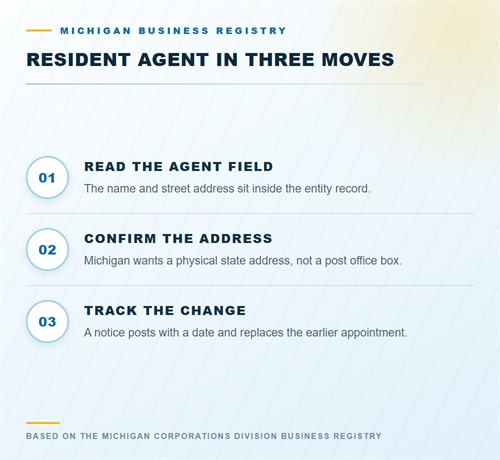
The agent field sits inside the entity record rather than in a separate register, so the lookup starts with the business. Open the registry portal, find the company, and read the block that names the agent and the address where service is accepted. The index itself is reachable from Michigan Registered Agent on the home page. The same block appears on the record for a corporation, an LLC, a partnership, and a foreign registration, and the wording is the same across the classes.
Search by Business Name
Enter the distinctive word from the company name and leave the ending off. Michigan returns every entity that carries the word, and the list shows the status beside each result. A company that is not in good standing still shows an agent, but the appointment may be stale, because an entity that stops filing also stops updating its fields. Confirm the status before treating the agent as current.
Search by File Number
The six-digit identifier is the shortest route to the record when a notice or a contract supplies it. Copy the number exactly, because the search treats it as a single token and a missing digit returns an empty page. Once the record opens, the agent block appears with the registered office and the filing history. A reader who has only a trade name should search the assumed name index before giving up.
Where the Field Sits
On most records the agent block follows the name, the file number, and the status. It lists the agent’s name, the address, and the registered office, which are related but distinct fields. The record does not show a telephone number or an email address for the agent. Those details come from the agent’s own record when the agent is a company, and from the business directly when the agent is an individual.
Department of Licensing and Regulatory Affairs:
https://www.michigan.gov/lara
What the Agent Field Shows
The field identifies the party that agreed to accept legal papers for the business. It is a role rather than an ownership interest, and the person named may have no financial stake in the company. A resident agent can be an owner, an employee, a lawyer, or a commercial service that serves thousands of entities. The record does not distinguish among those arrangements, so the name alone does not say why that party was chosen.
The address beside the name is the place where service is accepted, and it can differ from every other address on the record. A commercial agent office may be the only Michigan location tied to a company that operates elsewhere. When two addresses on a record conflict, the registered office controls service, and the principal office answers the operational questions. Read the labels rather than assuming the first address is the one that matters.
Individual Agent
An individual agent is usually an owner, a family member, or a local professional who agreed to the role. The record shows a personal name and a Michigan street address, and both become public. An individual who moves has to be replaced by a filing, and a resignation without a replacement leaves the entity without a valid agent until one is appointed. A notice sent to the old address may never reach the company.
Commercial Agent
A commercial agent is a company that provides the service for a fee, and its name appears in the agent field for every client it represents. The address is usually the agent’s office, which is a physical Michigan location that can accept delivery during business hours. When the agent is a company, check its own registration and its standing, because an agent that has lost good standing cannot reliably accept service for anyone.
Who Can Serve in Michigan
Michigan limits the role to a narrow set of parties, and the limits exist so that service can actually be completed inside the state. Eligibility is limited to an adult resident, a Michigan corporation, or a Michigan LLC, and the address has to be a physical state location. A post office box is refused. The agent also signs the formation document or the notice that appoints it, which is the state’s evidence of consent.
Residency and Age
An individual agent must be an adult who lives in Michigan. A person who works in the state but lives elsewhere does not qualify, even when the office is in Detroit or Grand Rapids. The requirement is about physical presence, because service of process depends on a person who can be reached at a Michigan address. A company that wants an out-of-state officer to serve should use a commercial agent instead.
Entity Agents
A Michigan corporation or a limited liability company can serve as an agent, and many do so as a business. The entity agent must itself be in good standing, which means its own annual report or statement has to be current. A foreign company cannot serve unless it has registered in Michigan and holds an active certificate of authority. The division checks the agent’s status when a filing names it, but it does not monitor the appointment afterward.
Address Rules
The agent address must include a street number, a street name, a city, and a ZIP code, and it must be a place where a process server can appear in person. A suite in an office building is acceptable, and a virtual office works only if it receives deliveries and staffs a desk. A mailbox store is not acceptable, even when it carries a street address. The division returns a filing that lists a box in the agent field.
Service of Process
Service of process is the delivery of a summons and complaint that starts a lawsuit, and the agent is the party that accepts it for the business. The same address receives subpoenas, tax notices, and formal demands from state agencies. When service is completed on the agent, the business is treated as having notice even if the owner never reads the papers. That rule is why the field matters more than its modest appearance suggests.
A well-run agent logs the delivery, scans the document, and forwards it the same day. A mail drop that forwards on a weekly schedule can cost a defendant the days needed to answer a complaint. A business that receives service should calendar the response date immediately, because the clock starts on delivery rather than on the day the owner opens the envelope.
What Gets Delivered
A process server delivers a summons, a complaint, and any exhibits, and the agent signs an acceptance or files an affidavit of service. State agencies deliver notices of assessment, license actions, and compliance warnings to the same address. A bank or a counterparty may send a demand letter there when a contract names the agent for notices. The agent is expected to forward the documents, and a commercial agent usually does so the same day.
Why a Stale Address Matters
A lawsuit served at an address the company no longer uses can still be valid if the record was not updated, and the company may learn about the judgment only when an account is frozen. The law puts the duty to keep the agent current on the business, not on the plaintiff. That is why a change of address or a change of agent is a filing with a deadline, and why a lapsed appointment is a risk that appears years later.
After a Default
A default judgment entered after service on a stale agent is difficult to undo. A court may set it aside when the business shows that the address was wrong through no fault of the plaintiff, but the burden sits with the defendant. The practical answer is to keep the field current and to name an agent that will forward documents. A commercial service with a documented forwarding process reduces the risk of a missed complaint.
Changing the Agent
A change of agent is a short filing, and it takes effect when the division processes it. The notice identifies the entity, the former agent, and the new agent, and the new agent signs to accept the appointment. The filing carries a small state charge, and the record then shows the new name and address with a processing date. Until that date, the former agent remains the agent of record.
A company should file the change before the new agent begins accepting mail, so the record and the practice match. A filing made after the move leaves a window in which a notice can reach the wrong address, and that window is where a default judgment is born. The change is cheap, and the delay is the expensive part.
Notice of Change
The notice can also change the registered office without changing the agent, which happens when a commercial service moves offices. A company that files the notice late leaves a window in which service goes to the old location. The division does not notify the former agent, and it does not notify the company beyond the filing receipt. The company is responsible for telling its own staff and its bank that the address changed.
Resignation and Replacement
An agent can resign by filing a notice with the division, and the resignation starts a short window for the entity to appoint a replacement. A company that ignores the window ends up without a valid agent, and the record shows the gap. The safer practice is to file the replacement together with the resignation, so the record never lacks an agent. A resignation filed alone is a signal that the entity may be hard to reach, while a replacement filed in the same session closes that gap.
Privacy and the Home Address
Michigan publishes the agent’s name and address, and an owner who serves as the agent therefore exposes a home address to anyone who searches the register. That exposure persists in the record and in archived copies. An owner who works from home should weigh the convenience of serving as the agent against the visibility that comes with the appointment.
Public Exposure
The field is open to the public without a login, and data brokers copy it into commercial directories. Removing it later requires a filing, and the older capture may persist on other sites. A home address that appears as the agent address can also be matched to the registered office when the business operates from the same place. The two fields together can reveal where the owner lives.
Options
A commercial agent address keeps the home address off the public file, and many small businesses choose that route for the privacy alone. A separate office or a coworking address can serve the same purpose when the lease permits mail delivery. Whichever route is chosen, the address must be a real Michigan location that accepts service, because a mail drop that refuses delivery defeats the appointment.
Agent Address and Registered Office
The record carries two addresses, and they are not interchangeable. Papers and agency notices arrive at the registered office, and the agent is whoever receives them at that address. The principal office, where the business operates, is a separate field. A company can share one location for all three, and many small businesses do, but the fields answer different questions.
Two Different Fields
The agent address belongs to the agent, who may be a third party. The registered office belongs to the entity and must be a physical Michigan address. When the agent is a commercial service, the two are usually the same office, and a notice sent to the principal office may not satisfy a statute that requires delivery to the registered office. Read the label on each field before sending anything.
Which Address Gets Notices
Court papers go to the registered office and the agent. Tax notices from the Treasury go to the address on the tax account, which may be the principal office or a mailing address. The division sends report reminders to the email on file and posts the form to the portal. A business that wants one place for everything can name its own office as the registered office, provided the agent rules are met.
Checking an Agent Before You Rely on It
An agent appointment is only as good as the agent’s own standing, and a check takes a few minutes. Look up the agent’s record when the agent is a company, confirm that its status is active, and compare the address on the agent record with the address in the client’s file. A mismatch is a sign that one of the two filings is stale. A commercial agent that has lost good standing is a risk the client may not have noticed.
Verify the Agent’s Registration
The agent’s record shows its own file number, status, and address, and the address should match the one in the client’s file. A company that provides agent services under an assumed name may appear under its legal name in the register, so search both. If the agent’s status is not active, the appointment is unreliable even when the client’s own record looks current. Ask the client to appoint a replacement before you rely on service.
Signs of a Stale Record
A stale field usually shows an address that no longer exists, a name that has been replaced at the same company, or a resignation filed without a replacement. The history shows the last agent change, and the date tells you how long the field has been untouched. When the record shows a compliance warning and an old agent, treat the appointment as doubtful until the client confirms it in writing. A certificate of good standing confirms the client’s status, not the agent’s, so check both.
Agent Fees
The division charges for the filings that change the agent field, and the amounts below cover the documents a company is most likely to submit. A routine notice waits in the division queue, while a rush request carries an extra charge. The portal takes a card payment, and a returned notice keeps the fee.
| Agent-related filing | State fee |
|---|---|
| Notice of change of registered office or agent | $5 |
| Annual statement, LLC | $25 |
| Annual report, profit corporation | $25 |
| Certificate of good standing | $10 |
| Certified copy of an agent filing | $16 plus $1 per extra page |
| Restoration of good standing | $50 |
Frequently Asked Questions
These questions come from owners, agents, and readers who received a notice. The answer to each names the record involved.
Is the resident agent the owner of the business?
No. The agent accepts legal papers and official notices. The role says nothing about ownership, and an agent may have no financial interest at all. A lawyer, a service, or an employee can hold the role, and none of them gains a stake by doing so.
Can I be my own resident agent in Michigan?
Yes, when you are an adult who lives in Michigan and you give a Michigan street address where you can accept delivery during business hours. A home address used for the role becomes part of the public file, which is why some owners use a service.
Can a post office box be used?
No. The division requires a physical Michigan street address for the registered office and for the agent. A suite is acceptable, and a mail drop that refuses delivery is not. The address must also be one where a process server can appear in person.
What happens if the agent resigns?
The entity has a short window to appoint a replacement. Until a new agent is filed, the record shows no valid appointment, and service may go to the last known address. File the replacement with the resignation so the record never shows a gap.
How much does it cost to change the agent?
The state charges the amount listed in the table above. A commercial agent may also charge its own appointment fee, which the state does not set. The state amount is fixed, while a commercial agent sets its own annual fee.